题目:Quest for very high intensities with X-rays
时间:2026年11月30日10:00
地点:光电大楼一楼党员活动室
邀请人:刘一 教授
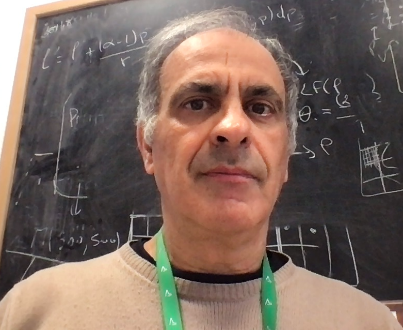
Prof. Philippe Zeitoun
Laboratoire d'Optique Appliquée, (LOA),
CNRS, École polytechnique,
ENSTA, Institut Polytechnique de Paris, Palaiseau, France
Abstract:
My research career was structured around the search of reaching very high intensities with X-ray beams in order to create a novel kind of plasmas or to generate highly non-linear effects in materials or vacuum. I followed two paths, improvement of plasma-based soft X-ray lasers and at-wavelength wavefront management, that quickly merged in a single topic. In this talk, I will first give a quick overview of different X-ray non-linear effects already observed or still under consideration, followed by a reminder about issues related to extreme focusing. Then I will show the most striking developments of plasma-based X-ray lasers achieved over the last 50 years and discuss about some pending projects. Finally, I will present our works on X-ray wavefront metrology and control considering both X-ray sources and X-ray optics. I will conclude by presenting some spinoffs of X-ray wavefront metrology.
Biography
Prof. Philippe Zeitoun graduated from University Paris VII, France, in 1990 on Fundamental Physics with speciality about large-scale infrastructures (laser, Tokamak and particle accelerators). In 1994 he received his PhD from University of Paris south entitled "Large-gain X-ray lasers emitting near 200 A". He then spent 13 months at the University of Essex inn U.K. where he pursued researches on X-ray lasers with demonstration of lasing in the so-called "water window" and where he studied plasmas created at low intensities (109-1010 W/cm2). He got a permanent researcher position in CNRS in 1995. Since, he worked on incoherent (Plenoptic) and coherent X-ray images (interferometry and holography) in parallel with researches on plasma-based X-ray lasers and X-ray metrology. In 2003, with coworkers, he published a foundational article on seeding plasma-based X-ray lasers, a technique that became the reference and that is also used on some X-ray free-electron lasers. Currently, he is head of the femtosecond FLUX group at Laboratoire d'Optique Appliquée where he pursues researches on plasma-based X-ray lasers, plasma probing and plasma creation with intense X-rays, 3D X-ray imaging, X-ray imaging for medicine.